What Does “Organic” Mean in Cosmetics?
How to tell when “organic” in cosmetics is certified—and when it’s just marketing.

Photo: Ibnu Ihza for Unsplash
The word “organic” carries real weight. But what does it actually mean in cosmetics?
In some cases, it reflects a verified certification. In others, it’s simply a marketing claim. Understanding the difference matters.
In food, “organic” signals regulated agricultural practices, environmental stewardship, and third-party oversight. In cosmetics, the same term is far less precise. There is no single global standard governing how it’s used across the category.
The result is a mix of rigorous certifications, category-specific standards, and plenty of gray area.
“Organic” is also often confused with natural, though the two are defined differently in cosmetics. For a closer look, see “Natural” in Cosmetics: What It Really Means.
A product may sound organic, look organic, or even contain organic ingredients—without being certified in any formal way. This is where many well-intentioned consumers get tripped up.
Here’s how to decode what “organic” really means in cosmetics.
Organic Certifications in Cosmetics: Key Differences
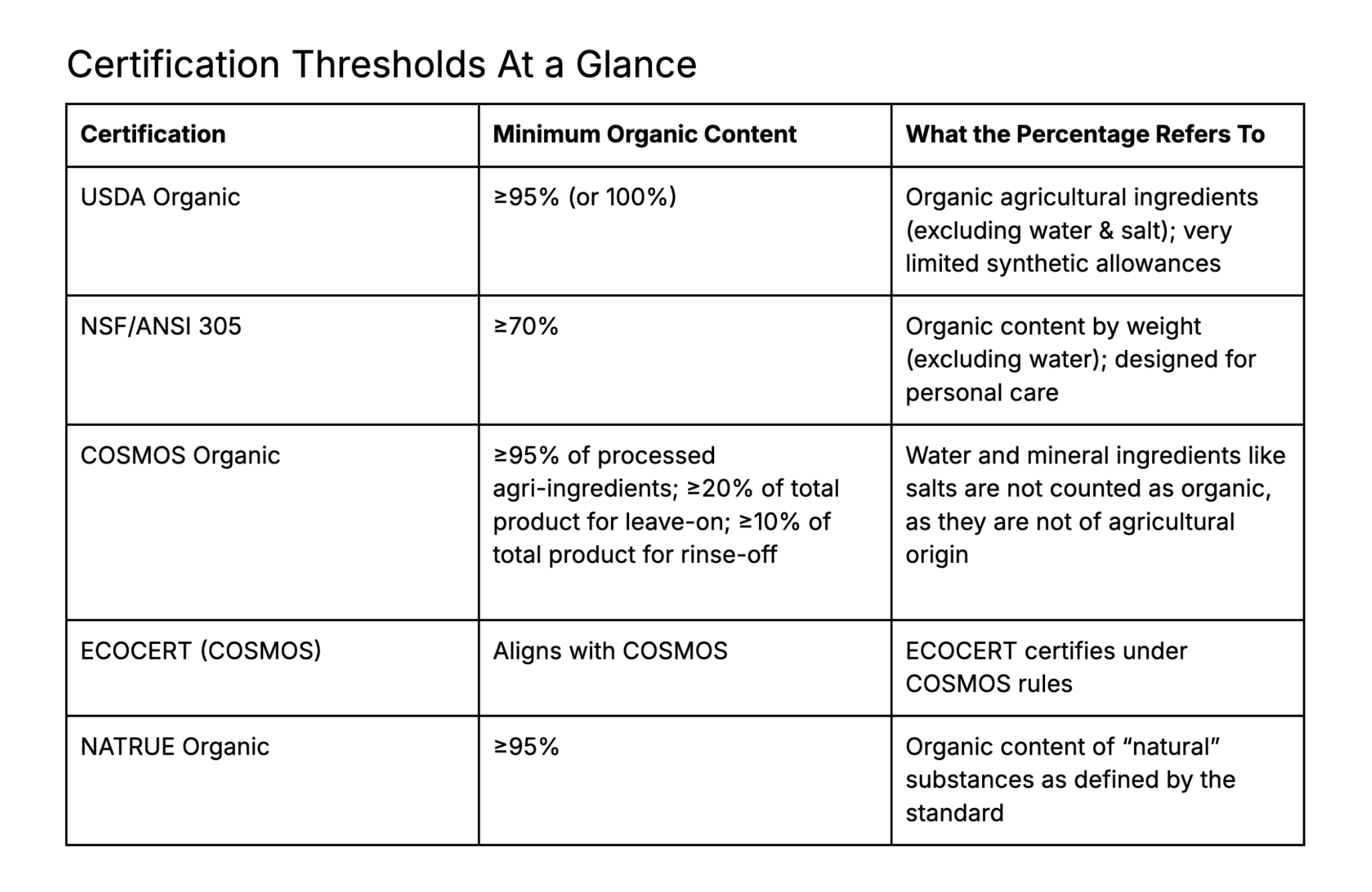
Not all certifications measure organic content the same way. USDA Organic applies strict food-based criteria, while others such as COSMOS and NSF/ANSI 305 are designed specifically for cosmetics and allow more formulation flexibility.
Can Cosmetics Be USDA Organic?
The USDA Organic seal is one of the most strictly regulated labels in the United States—but it was designed for food, not cosmetics.
It governs how agricultural ingredients are grown, handled, and processed, not how finished cosmetic products are formulated.
That distinction matters. Because while the USDA standard is rigorous, it is also highly restrictive for modern cosmetics.
To qualify for the USDA Organic Seal:
100% Organic products must contain only organically produced ingredients (excluding water and salt).
Organic (≥95%) products must contain at least 95% organically produced agricultural ingredients.
Synthetic ingredients are largely prohibited, with only limited exceptions.
These requirements create a practical limitation. Most cosmetic formulations rely on preservatives, emulsifiers, stabilizers, and other functional ingredients that do not qualify under USDA rules.
As a result, only a narrow subset of products—typically anhydrous oils, balms, butters, or simple aqueous plant extracts—can legitimately carry the USDA Organic seal.
What Is NSF/ANSI 305 for Organic Cosmetics?
Developed in the United States specifically for cosmetics, the NSF/ANSI 305 standard requires that:
Products must contain at least 70% organic ingredients by weight (excluding water).
Products can only use approved claims including “Made with Organic Ingredients” or “Contains Organic Ingredients.”
Certification requires third-party verification, ingredient traceability, and compliant labeling.
Products carrying this certification can be found on the NSF website.
What Is COSMOS Certification in Cosmetics?
COSMOS is a widely used international standard developed specifically for cosmetics. It’s applied by multiple European certifiers—including ECOCERT, BDIH, ICEA, COSMEBIO, and the Soil Association—so products may carry different logos while meeting the same underlying criteria.
The key is understanding that COSMOS has two distinct tiers, which are often confused:
COSMOS Organic
≥95% of physically processed agricultural ingredients must be organic
≥20% of the total product must be organic (≥10% for rinse-off products)
Water is excluded from calculations
A limited list of approved synthetic ingredients is allowed for safety and stability
COSMOS Natural
No minimum organic content requirement
Restricts petrochemicals, GMOs, irradiation, and certain processing methods
COSMOS maintains a public directory of certified products, making it one of the more transparent systems available to consumers willing to look beyond the label.
What Is ECOCERT—and How Is It Different from COSMOS?
ECOCERT is one of the founding members of COSMOS — but its logo is far more recognizable to U.S. consumers than most other COSMOS certifiers. That visibility often leads shoppers to assume ECOCERT represents a separate or stronger standard, when in reality:
ECOCERT certifies products to COSMOS criteria
The ECOCERT logo identifies who performed the certification
The COSMOS designation (Organic vs. Natural) determines what standards were met
What Is NATRUE Certification in Cosmetics?
NATRUE by the International Natural and Organic Cosmetics Association is widely recognized as a natural cosmetics standard, but it also includes a clearly defined Organic Cosmetics tier.
Here are some nuances of the standard:
As a baseline, the products should be made up only of 100% natural, derived natural and natural-identical substances.
To qualify for Organic tier, organic content should be ≥95% of all natural substances
The NATRUE seal is not granted on a single product basis; it is awarded to brands or sub-brands committed to the production of natural and organic cosmetics.
While NATRUE’s organic criteria are explicit and rigorous, products carrying this specific designation are rare in the US marketplace.
Are Organic Cosmetics Better or Safer?
An organic certification does not automatically mean a product is:
safer
more effective
preservative-free
suitable for sensitive skin
environmentally superior in every dimension
Organic ingredients can still oxidize, irritate, spoil, or underperform if poorly formulated. Safety and efficacy depend on formulation quality and not just ingredient origin.
A product without an organic seal isn’t inherently inferior. And a product with one isn’t automatically superior. What matters is being able to tell the difference and knowing what questions to ask.
How to Read “Organic” Claims on Cosmetic Labels
“Organic” in cosmetics can be meaningful — but only when tied to a verifiable standard designed for the category. USDA Organic remains highly restrictive and rare. Cosmetics-specific certifications offer more flexibility, but require careful reading.
When checking labels:
Ask which standard — not how the claim sounds.
Look for the emblem of the certifying body on packaging or brand websites.
If no certifier is named, “organic” is likely descriptive, not regulated.
“Organic” is just one of many terms used to shape how products are perceived. Claims like “non-toxic” or “clinical grade” follow similar patterns—often sounding precise, but lacking consistent definitions. For a broader look at how these terms are used across the industry, see From Non-Toxic to Clinical Grade: Decoding Buzzy Cosmetic Claims.
Birnur Aral, PhD, is a chemical engineer and consumer product expert with a career spanning research and development, testing, and sustainability. She brings a rigorous, evidence-first lens to product claims and consumer-facing topics.