What to Look for When Buying a TV
Find out what actually matters for TV buying, and what's just noise from experts.

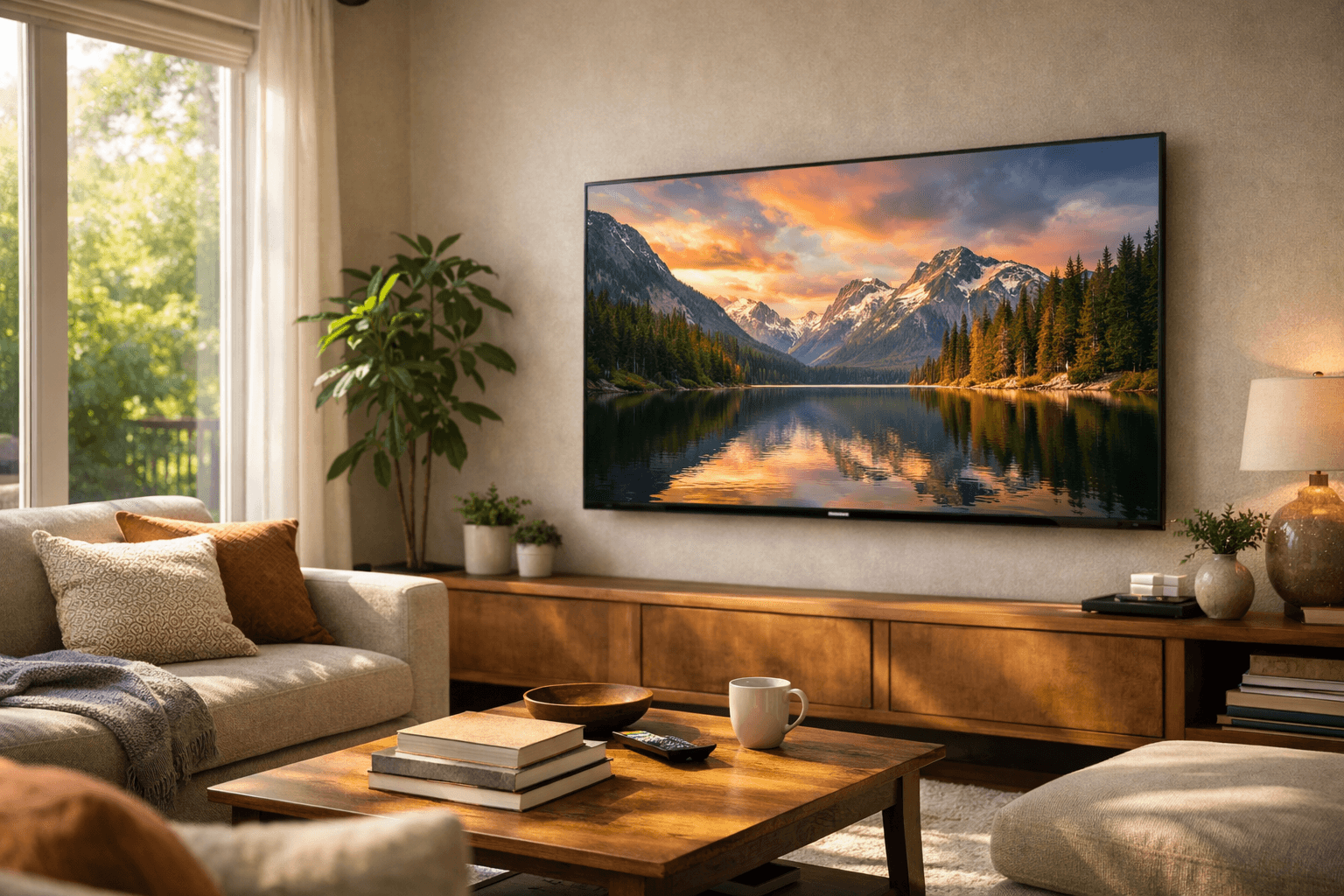
Photo: ChatGPT
Choosing a TV in 2026 means navigating a flood of new terminology: micro RGB, SQD-mini LED, tandem OLED, agentic AI. The technology is advancing quickly, but the core factors that determine whether a TV looks good in your home remain surprisingly consistent. After nearly two decades of testing displays and reviewing this year’s latest models, here’s what actually matters when it comes time to buy.
The Fundamentals That Still Matter
Before diving into the newest display breakthroughs, it helps to ground yourself in a few fundamentals that have mattered for years, and still do.
Start With Size Because It Shapes Everything
TV screens are measured diagonally, corner to corner, not side to side. That 65-inch number refers to the diagonal of the visible screen, not the width of the set or the frame around it. And in 2026, 65 inches has quietly become the new baseline for most living rooms.
If you’re sitting six to eight feet away, a 65-inch 4K TV delivers immersion without overwhelming the room. Smaller spaces may feel more balanced with 55 inches, while larger, open layouts can comfortably accommodate 75 inches or more. You don’t need to obsess over formulas, but a helpful rule of thumb is this: with a 4K TV, sitting somewhere between one and one-and-a-half times the screen size away generally feels right. The goal isn’t mathematical precision; it’s avoiding the two most common regrets: buying too small and wishing you’d gone bigger, or buying something so large that watching becomes visually tiring. Size, more than any other spec, is what changes your experience the most.
4K Is the Go-To Resolution, 8K Is Still Optional
Once size is settled, resolution is the next logical step. Today, most sets are either Full HD (1080p) or 4K (Ultra HD). If you’re buying anything 55 inches or larger, 4K is no longer a luxury; it’s the expectation. It keeps images sharp and detailed at typical viewing distances and ensures compatibility with modern streaming content.
As for 8K, despite the marketing push, there is still very little native 8K content available. A high-quality 4K OLED will almost always outperform a budget 8K set because picture quality depends far more on panel performance than raw pixel count. Resolution matters, but only in context. More pixels don’t automatically translate to a better image if the underlying hardware isn’t strong.
What's Actually New and What Isn't
How the TV Handles Light is the Real Differentiator
While marketing might lead you otherwise, picture quality doesn’t separate itself at the resolution level. It separates itself in brightness and contrast. In bright, sun-filled rooms, Mini-LED and newer RGB Mini-LED displays excel because their powerful, precisely controlled backlighting helps combat glare and prevent washout. They maintain clarity during daytime viewing and perform well in spaces with large windows or open layouts. These are practical choices for real homes, where lighting conditions change throughout the day.
If most of your viewing happens at night or you care deeply about cinematic depth, OLED remains the gold standard. Because each pixel produces its own light, OLED panels deliver true blacks and exceptional contrast. In darker rooms, that self-lit precision creates a level of dimensionality and realism that’s still difficult to match.
Newer ultra-bright technologies, including “Super Quantum Dot” Mini-LED sets introduced by brands such as TCL, push brightness to eye-catching levels, sometimes advertised up to 10,000 nits. It’s impressive engineering, but unless your TV is competing with floor-to-ceiling sunlight throughout the day, that level of luminance is often more headline than necessity. Matching the panel to your room’s lighting will have a far greater impact than chasing the brightest spec available.
AI Is Helpful, But It’s Not Magic
Artificial intelligence has become the marketing centerpiece of many 2026 models. Terms like “Agentic AI” or “Affectionate Intelligence” suggest something transformative. In reality, what most of these systems do is automatically adjust brightness, contrast, sharpening, and motion processing in real time based on what’s on screen.
That refinement can absolutely improve consistency, especially when streaming lower-quality content. But it’s important to understand its limits. AI cannot compensate for weak hardware. A mid-range panel marketed with “AI-enhanced color” won’t outperform a genuinely high-quality display built with better optics and light control. Think of AI as a finishing touch, it can polish a strong foundation, but it can’t rebuild it.
Software Support: The Feature Buyers Overlook
One of the most meaningful developments in the TV market has little to do with picture quality; it’s software longevity. Smart TVs rarely become obsolete because their screens fail. More often, they age because apps stop updating, streaming platforms lose compatibility, or the interface slows over time. Some manufacturers now promise up to seven years of operating system updates on certain premium models. That kind of commitment can significantly extend a TV's usable life and protect your investment.
If you expect to keep your television for five to ten years, which many households do, long-term software support deserves serious consideration. A slightly brighter panel won’t matter if the apps you rely on no longer function smoothly a few years down the line.
Don’t Forget the Sound
As TVs have become thinner, some measuring under 10 millimeters (similar to the thickness of a pinky finger), built-in speakers have inevitably shrunk. Even the best panels can feel underwhelming if dialogue sounds flat or difficult to understand.
For viewers who care about movie nights, sports, or simply clear conversation during streaming shows, a soundbar shouldn’t be viewed as an optional add-on. It’s part of the overall system. Allocating a portion of your budget to audio often delivers a more noticeable upgrade than marginal improvements in brightness or processing power.
The Bottom Line
The TV market in 2026 is full of innovation. Some of it is meaningful, much of it is marketing. The fundamentals, however, remain steady: choose a size that fits your room and viewing distance, opt for 4K over 8K (unless price has zero bearing for you!), match the panel type to your lighting conditions, pay attention to long-term software support, and budget thoughtfully for sound. Because the best TV isn’t the brightest, the thinnest, or the one with the most buzzwords. It’s the one that performs consistently in your home, long after the showroom glow fades.
Rachel Rothman is a mechanical engineer and consumer product expert with deep experience in product testing, evaluation, and industry standards. She applies a rigorous, performance-first approach to assessing products across categories, translating technical insights into clear guidance that helps consumers make informed decisions.