Why “Calm” Is No Longer My Goal
What parenting taught me about regulation, resilience, and why calm isn’t the measure of success

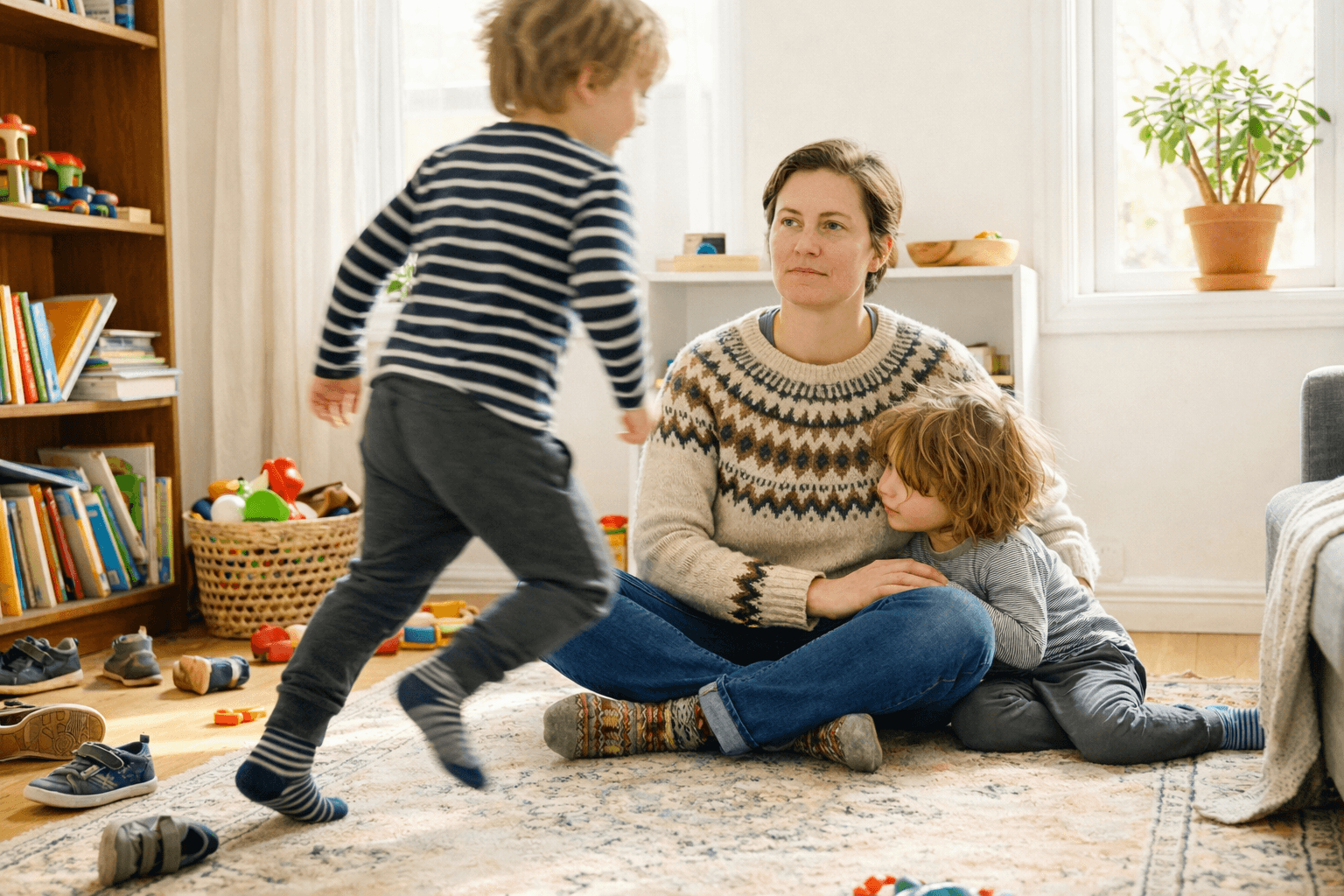
Photo: ChatGPT
For a long time, I thought calm was the goal. For my kids. For myself. For our home. If things felt loud or emotionally charged, I assumed something was wrong. Calm felt like proof that I was parenting well, that things were under control. I didn’t question it. I just aimed for it. Parenting has a way of unraveling assumptions.
The shift didn’t happen all at once. It happened in moments that couldn’t be quieted or rushed through. Moments when calm simply wasn't accessible, no matter how prepared I was or how badly I wanted it. There were times when my child needed to move, cry, or fall apart a little before coming back together. And I started noticing something uncomfortable: when I pushed for calm too quickly, things escalated. We became more rigid, more frustrated, more disconnected. I was trying to land somewhere that wasn’t available yet. The turning point came when I stopped asking, “How do I make this calm?” and started asking, “What helps us move through this?”
That’s when regulation clicked. Regulation isn’t about being calm. It’s about having the capacity to experience a wide range of emotions without getting stuck. It’s flexibility and recovery. The ability to feel activated, frustrated, overwhelmed, and find your way back. Calm is a state, whereas regulation is a skill. And I feel like as a society we’ve been conflating the two for a long time.
Much of what we now understand about emotional resilience, thanks to researchers, educators, and thinkers like Brené Brown, points in the same direction: emotions aren’t problems to solve, but experiences to move through.
Why Calm Is So Prized
Part of why calm may feel like the goal, especially for parents, is that it’s been quietly equated with goodness. A calm child is often read as well-behaved. A calm household is a successful one. A calm adult is someone who has it together.
Calm is tidy, and it reassures the people around us that nothing needs attention. But calm has also become shorthand for control, productivity, and emotional restraint. In schools, workplaces, and even families, we tend to reward people who can suppress emotional expression far more than those who know how to move through it.
This isn’t malicious, it’s cultural. Calm is easier to manage than complexity as it fits more neatly into systems designed around efficiency and order. Big feelings slow things down, and for many, dysregulation is an inconvenience.
The problem is that when calm becomes the requirement instead of a momentary state, kids and adults learn that activation is failure. That emotions are acceptable only once they’re already under control.
Unlearning “Good” Behavior
Many of us grew up learning that being “good” meant being composed. You may have heard a parent or teacher say things like: Don’t make a scene, use your inside voice or take a breath and calm down. Those messages weren’t inherently wrong or malicious, but they were incomplete.
What often went unmodeled was what happens before calm, and what happens after it’s lost. We learned performative measures instead of the foundational blocks for rebuilding regulation.
Parenting has a way of exposing that gap (and many others!). Kids feel first, think later. Their emotions show up in their bodies, not as neatly packaged concepts. If we expect calm as the starting point, we miss the chance to teach something more durable: how to recognize what’s happening, name it, and find a way back.
Where Science Aligns
Across psychology and education, there’s growing recognition that emotional strength isn’t about composure; it’s about capacity. Frameworks like the RULER approach from the Yale Center for Emotional Intelligence focus on recognizing, understanding, labeling, expressing, and regulating emotions. The goal isn’t calm at all costs; it’s emotional literacy and flexibility.
The ability to feel, recover, and re-engage, without shame. In recent years, researchers and educators have begun to articulate what many parents intuitively experience: emotional regulation isn’t about eliminating big feelings, it’s about building skills around them. What matters is whether there’s support, safety, and a reliable way back. Resilience isn’t about constant balance; it’s about the ability to move between states without shame and to recover.
What This Changed for Me
Seeing this reflected in both research and real life helped me trust what I was learning through my kids. I try to recognize dysregulation, mine or theirs, not as a sign that something has gone wrong, and start to see it as information. As a signal that something needed support, not suppression.
It also changed how I thought about myself. I realized how often I had treated calm as proof that I was doing things “right.” How much pressure I put on myself to respond evenly, to smooth things over quickly, to stay composed even when I was depleted.
What actually helped wasn’t tighter routines or better self-control. It was learning how to recover. Learning when to step away before responding. When to loosen instead of tighten. When to let a moment crest rather than try to cap it early.
Once I stopped chasing calm, I started designing my days and my expectations around regulation instead. Around support. Around the reality that some days are louder, messier, and more emotionally charged than others.
That shift has shaped how I parent, how I work, and how I think about help more broadly. I’m far less interested now in advice that assumes you’re starting from a rested, regulated place. I’m far more drawn to tools and systems that acknowledge reality, ones that meet people where they are and help them find their footing again.
The most useful support doesn’t demand calm. It doesn’t ask you to override your nervous system or pretend things are easier than they are. It allows for movement. For repair. For return. Calm is a moment. Regulation is a skill.
And once I stopped treating calm as the goal, for my kids and for myself, everything didn’t become quieter or easier. But it did become more honest. More workable. And, over time, more steady.
Rachel Rothman is a mechanical engineer and consumer product expert with deep experience in product testing, evaluation, and industry standards. She applies a rigorous, performance-first approach to assessing products across categories, translating technical insights into clear guidance that helps consumers make informed decisions.